









|
|
|
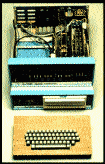
basic Altair
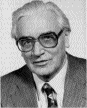
Konrad Zuse
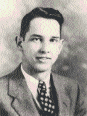
Alan Turing
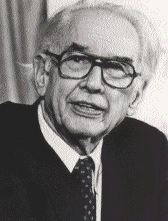
John Vincent Atanasoff
|
John Vincent Atanasoff 1903-1995
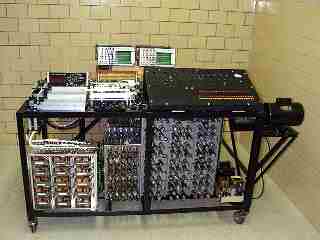
John Vincent Atanasoff, true inventor of the digital electronic computer, was born on October the 4th 1903 near Hamilton, New York. The Atanasov family name had been changed into Atanasoff by immigration officers on Ellis Island when Bulgarian Ivan Atanasov came to America in 1889 at the age of thirteen. He was accompanied by an uncle. His own father had been murdered by soldiers of the Ottoman Empire during the April Uprising of the Bulgarians against the Turks in 1876, the same year Ivan had been born. The year John Vincent was born the family moved to Osteen, Florida, and from there to Brewster, Florida. It was there that he attended grade school, and learned the basics of electricity from his father, an electric engineer. Somewhere around 1913 Ivan, who had changed his first name into John, bought a Dietzgen slide rule. Son John Vincent was immediately interested and very quickly learned everything about the mathematical background of the apparatus. His mother, Iva Lucena Atanasoff-Purdy, who was a mathematics school teacher, then helped him to understand the book, A College Algebra, by J.M.Taylor. It was then that he learned about number bases other than ten, including the vital basis two, the basis of bits and bytes. The family moved to a farm in Old Chicora, Florida. John Vincent completed the Mulberry High School course in two years with excellent results in science and mathematics. In 1921, he entered the University of Florida in Gainesville, where he took electrical engineering courses. At the same time he became interested in electronics. In 1925 he graduated with a Batchelor of Science degree in electrical . He accepted the first offer of teaching fellowship he got, although he received many more, even by Harvard. In the summer of 1925 22 year old John Vincent Atanasoff went to Ames, Iowa, home of the Iowa State College, later Iowa State University. In June 1926 he received his Masters degree in Mathematics from Iowa State College. A few days later he married Lura Meeks, whom he had met on the campus at the Dixie Club, a club for southern students. Atanasoff wrote his doctoral thesis:" The Dielectric Constant of Helium" at Madison, Wisconsin, and it was here that he found the same arduous work Konrad Zuse encountered doing his research, and like Zuse it made him think of finding a way to deal with it. And he would find it! After receiving his Ph.D. in theoretical physics in July 1930 Atanasoff returned to Iowa State College, where he would build his machine for faster and better computing. He was soon promoted assistant professor in mathematics and physics. After scrutinous research he had divided existing computing machines into two groups: on the one side the analogue machines, and on the other side what he called: "computing machines proper". Years of hard labor and frustration followed, not achieving the results he wanted. One night, in winter 1937, he got his car and went off for a ride, far and fast, with no specific destination. Two hundred miles further, in the state of Illinois he stopped at a roadhouse and had a drink. There, at that table, all the pieces fell together. He got a clear vision on how his computing machine had to be built. Back home in Iowa he formulated his ideas and in 1939 the College gave him a grant of $ 650 to start work on his machine. Atanasoff found a brilliant electrical engineering student, Clifford E. Berry to assist him on the project. Together they worked on the project from 1939 until 1941, practically finishing it. The ABC, as it was called later, had been invented.
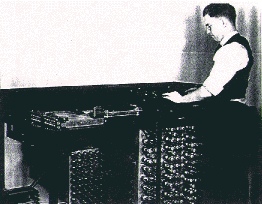
Clifford E Berry, working on the
ABC Unfortunately the patenting of the ABC was never completed, despite the fact that Iowa State College had hired Chicago patent lawyer Richard R. Trexler.
Mauchly and the ABCIn 1940 Atanasoff attended a lecture by John Mauchly. While discussing things after the lecture, Dr. Mauchley asked Atanasoff to show him his "computer". Unfortunately John Vincent agreed and showed Mauchely the ABC explaining its functioning. Later, Mauchley used many of these ideas when building the famous ENIAC, together with Dr. Eckert. The ENIAC was based on Atanasoff's ideas, and therefore not the first electronic digital computer. Not until 1972 would Atanasoff be granted the honor and recognition he deserved. U.S.District Judge Earl R. Larson ruled that the ENIAC was "derived" from the ideas of Dr. Atanasoff. J.W. Mauchley 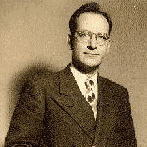
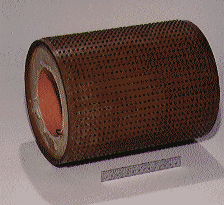
The problem in defining what was the first computer is always the definition of a computer itself. In historical perspective the first "Computer-like" machines were Zuse's Z1, Z2 and Z3. They used the binary number system; they used floating point numbers along with algorithms for translation between binary and decimal and vice versa as well as the carry look-ahead circuit for the addition operation. From the point of electronic computing device the ABC can be seen as the first. The memory used by Atanasoff and Berry was a splendid innovation too. On December 7 1941 America embarked on World War II. As early as September 1939 Atanasoff got what he thought to be a temporary job, a position at the Naval Ordnance Laboratory in Washington, D.C. He became Chief of the Acoustics Division, where he was in charge of developing a computer for the United States Navy. He was also involved in the first atomic test in the Pacific. At one of his visits to his family at Ames he found out that his ABC had been dismantled. No one had notified him or Clifford Berry. Just a few parts of the computer were saved.
In 1949 he became a chief scientist for the Army Field Forces in Fort Monroe, Virginia. and one year later he became Director of the Naval Fuse Program at the Naval Ordnance Laboratory in Washington D.C. In 1952 he established his own firm: The Ordnance Engineering Corporation in Rockville, Maryland, which was sold to Aerojet General Corporation in 1957. He stayed there, first as Manager of the Atlantic Division, and later as Vice-president. In 1961 he retired. The 1972 Verdict on the patents of Mauchley and Eckart was a major victory for him.
Honors
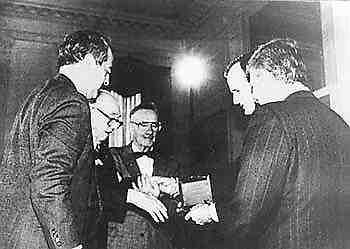
President George Bush presents the National Medal of Science and Technology for 1990 to John Vincent Atanasoff.
John Vincent Atanasoff died of a stroke on June the 15th 1995 in Maryland.
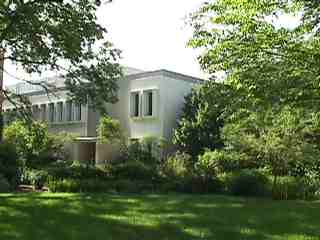
Biography based on Iowa State University bio with additional information provided by Mr. Petko Kolev. Atanasoff Hall, Ames, Iowa State University
See for more information about these festivities the TANGRA TanNakRa pages at: |
|
Send mail to mailto:tresmont@wxs.nl with questions or
comments about this web site. |